
by Youssef Elbeqqal · September 21, 2026
What to Do When Clients Are the Ones Holding Up Approval
TL;DR
A creative deliverable that should get a client response in 48 hours regularly stretches into two weeks once feedback arrives split across email, a marked-up PDF, a Loom video, and a text message that all need reconciling into one set of notes. The fix isn't automating that reconciliation away, it's giving the client one place to respond so a person only has to read one thread instead of chasing four.
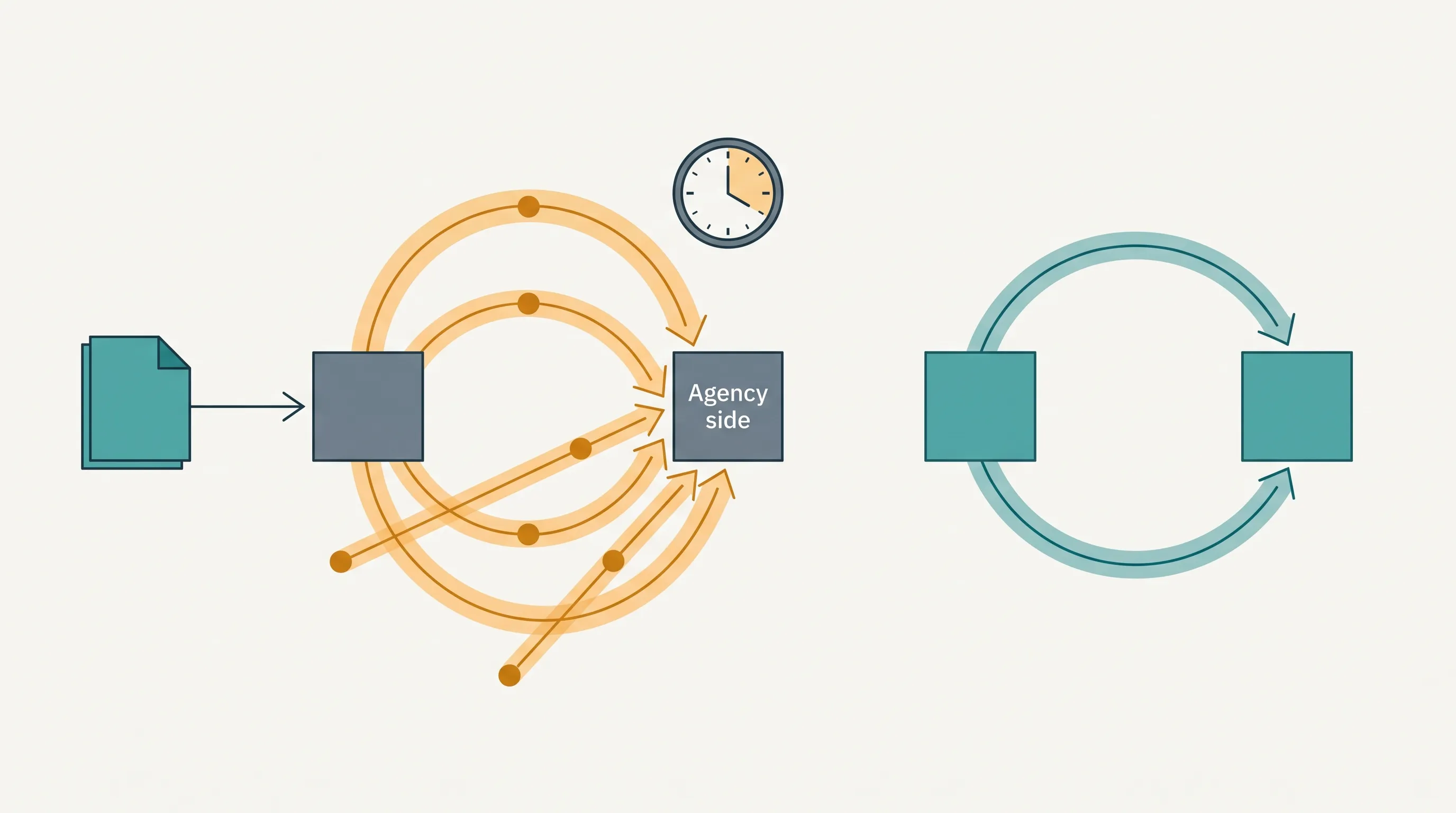
A deliverable goes out Tuesday with a two-day turnaround built into the timeline. Two weeks later it's still not approved, and nobody on the agency side did anything wrong. Sam McKay's account of a typical approval cycle lays out exactly how that happens: feedback comes back through an email thread, a marked-up PDF, a Loom video, and a text message, from three different people on the client side who don't agree with each other. Someone has to read all four, reconcile the contradictions, and guess which note wins. McKay puts the annual cost of that friction at $60,000 to $180,000 in lost margin for a mid-sized agency, not from any single project, just from this happening on repeat.
The fix isn't a smarter internal process
It's tempting to read that story as a workflow problem on the agency's side and respond by tightening internal review rounds. That helps, but it doesn't touch the actual bottleneck here, which is what happens after the agency's work is done and the client hasn't answered yet. The reconciling happens because the client's own feedback never had one home to begin with.
Where McKay's fix goes too far
McKay's recommended solution is an AI agent that watches email, Slack, and file storage, consolidates the scattered feedback automatically, and orchestrates the approval process on its own. That's the wrong amount of automation for anything a client sees. Automating the reconciliation itself hands a judgment call to a system that a person is still better at: deciding which of three conflicting notes actually reflects what the client wants. What's worth automating is upstream of that decision, not the decision itself.
What actually closes the gap
Give the client one link to respond to, not four channels to be chased through. A single approval thread doesn't stop clients from being slow, but it stops "slow" from also meaning "scattered," which is the part that turns two days into two weeks. MydropAI's SLA framework sorts requests into explicit turnaround tiers instead of one vague "let us know" window, which does double duty: the client knows exactly when a response is expected, and when a request sits past that window, it's visible to the agency instead of quietly aging in someone's inbox.
Where this fits into approvals overall
This is the client-side half of why approval bottlenecks cost agencies billable hours: internal review speed and client response speed are two different bottlenecks, and fixing one doesn't fix the other. See how workflow design gives a client one place to respond instead of five ways to go quiet.