
by Youssef Elbeqqal · September 5, 2026
The Client Offboarding Checklist Agencies Skip
TL;DR
When a client relationship ends, most agencies have no formal offboarding process: access isn't revoked, assets aren't handed off, and the exit conversation that could save the account or generate a referral never happens. A repeatable checklist closes all three gaps at once.
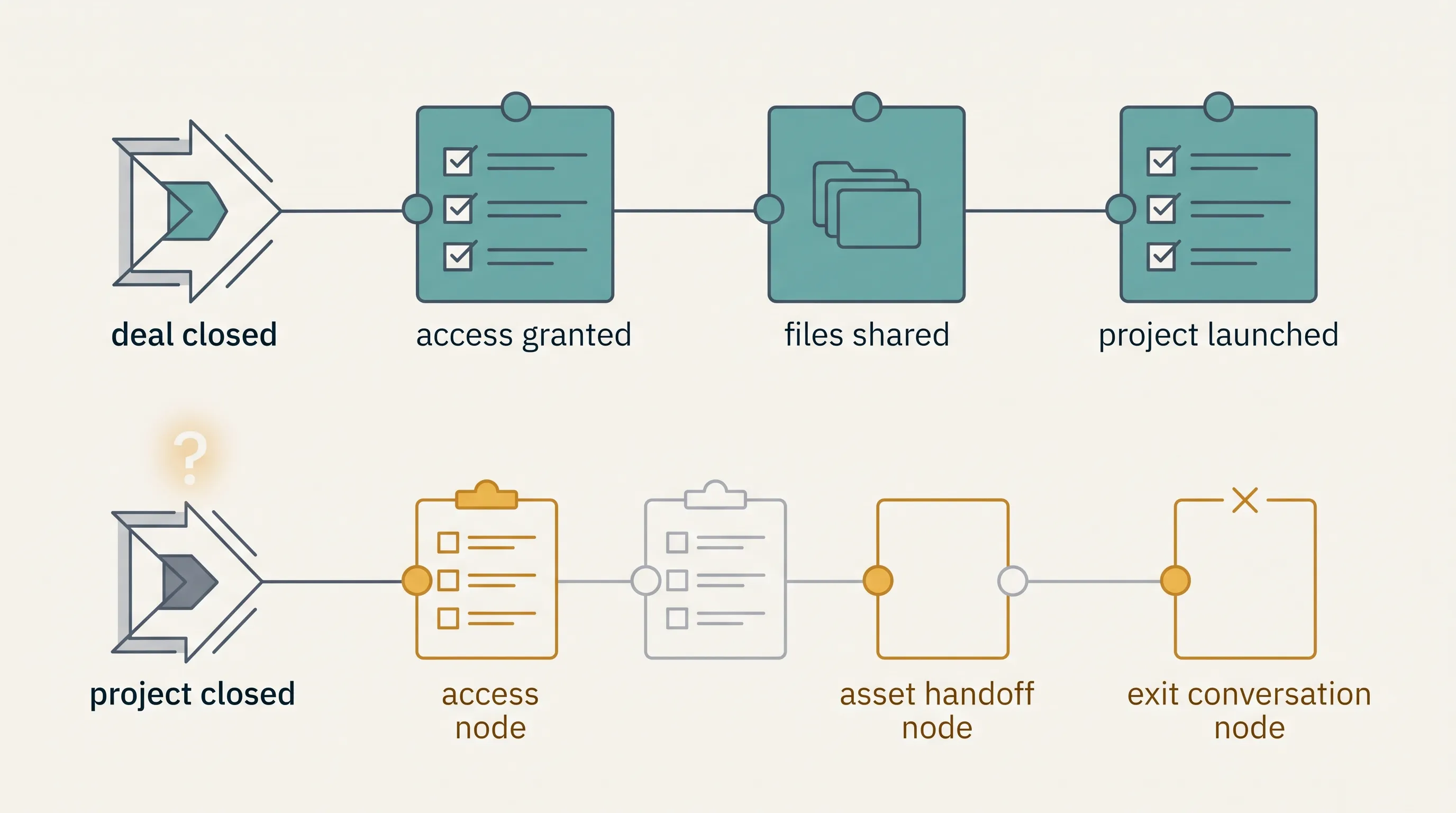
A client relationship ends and there's rarely a plan for it. Onboarding gets a checklist, a project template, sometimes a whole playbook. Offboarding gets whoever remembers to revoke Slack access before it slips their mind.
Why offboarding never gets built
Onboarding has a built-in trigger: a deal closes, revenue is on the line, and someone makes sure the checklist runs. Offboarding has no equivalent moment. Nobody schedules a checklist for work that's ending instead of starting, so it defaults to memory, and memory is exactly what breaks first once the account stops being top of mind.
The access nobody remembers to revoke
The gap shows up first as a security problem, not a process one. Even in employee offboarding, where companies have far more incentive to get this right, 38% of employees report accessing a prior employer's accounts after leaving. Client offboarding runs on weaker discipline than that: shared drives, dashboards, and platform seats granted over the life of an account rarely get revoked as a matter of routine when the account closes.
The exit that's actually a retention opportunity
Treating offboarding as a formality also means missing it as a save opportunity. One customer success platform found that a structured exit process reversed 25% of cancellation requests, worth roughly $56,000 in two months. A cancellation request isn't automatically a closed door if there's a real conversation instead of a silent exit.
What a repeatable offboarding actually looks like
The fix is the same shape as fixing onboarding: stop relying on someone to remember, and make the process self-tracking. A project status change to "closed" should trigger the checklist on its own: revoke platform access, archive shared files, schedule the exit conversation, log the reason the client left - instead of hoping whoever's closest to the account handles it manually.
How this fits with the rest of agency ops
This is the same underlying pattern behind why agencies default to hiring instead of fixing the process: a repeatable step running on memory instead of a system. See how Automatoro's approach to agency workflows turns steps like this into something that tracks itself, on both ends of the client relationship.